
Why Is My Body Stuck in Fight-or-Flight? How to Finally Reset Your Nervous System
Constantly exhausted, shallow breathing, tense shoulders, and unable to truly relax? Understand why your autonomic nervous system gets locked in sympathetic overdrive and how gentle somatic care helps your body rest.
1. The Modern Epidemic of Being 'Tired, Wired, and Braced'
You lie down in bed after an exhausting day, completely depleted in every bone of your body. You turn off the lights, close your eyes, and wait for sleep to take over. But instead of settling into deep rest, your heart begins to pound gently against your ribs. Your mind jumps from one racing thought to the next. Your shoulders remain elevated toward your ears, and your stomach feels like a tightly wound spring.
You are exhausted, yet utterly incapable of settling down. You are, as so many people express today, "tired, wired, and braced."
In our modern, high-speed culture, millions of individuals spend years—sometimes decades—living in this exact state of internal conflict. You might experience chronic muscle tension in your upper back and jaw, shallow chest breathing, digestive disruptions, hyper-reactivity to small stressors, or a persistent sense of impending urgency even when sitting peacefully on your couch.
When you ask yourself, Why is my body stuck in fight-or-flight?, it is easy to assume that your body is malfunctioning. But what you are experiencing is not a failure of design; it is an extraordinary biological system working precisely as designed, under conditions it was never meant to sustain indefinitely.
2. The Biology of the Braced Body: Sympathetic Overdrive vs. Parasympathetic Ease
To understand how to reset your nervous system, we must look at the balance of your Autonomic Nervous System (ANS). The ANS operates like an invisible internal thermostat, divided into two main branches:
The Sympathetic Nervous System (The Accelerator)
This is your "fight, flight, or freeze" mechanism. When your brain perceives a threat—whether it is a saber-toothed tiger in ancient times or an overdue bill, a difficult email, or a traffic jam today—the sympathetic system fires up instantly.
Adrenaline and cortisol flood your bloodstream. Your heart rate elevates, blood pressure surges, breathing becomes shallow and quick, pupil size expands, and blood is diverted away from non-essential internal organs (like digestion and immune response) and channeled into your arms and legs so you can run or fight.
The Parasympathetic Nervous System (The Brake)
This is your "rest, digest, and heal" state. Governed largely by the vagus nerve, the parasympathetic system slows down your heart rate, deepens your diaphragmatic breathing, stimulates healthy digestion, aids tissue repair, and signals to your mind that you are safe to drop your guard.
| Body Function | Sympathetic Overdrive ("Fight-or-Flight") | Parasympathetic state ("Rest & Repair") |
|---|---|---|
| Breathing Pattern | Shallow, rapid chest breathing | Deep, rhythmic diaphragmatic breathing |
| Muscular System | Braced, elevated shoulders, clenched jaw | Soft, pliable, natural postural alignment |
| Digestive Tract | Inhibited (bloating, constipation, acid) | Active, optimal nutrient absorption |
| Heart Rate | Elevated, low Heart Rate Variability (HRV) | Calm, flexible, healthy HRV |
| Mental Focus | Hyper-vigilant, scanning for threats | Calm, connected, present, clear-headed |
In a healthy system, you fluidly shift into sympathetic mode to handle a temporary challenge and then return effortlessly to a parasympathetic state once the challenge has passed.
However, modern life provides a continuous stream of subtle micro-stressors without clear resolution. When stress becomes chronic, the internal switch gets rusted in place. Your nervous system remains locked in sympathetic overdrive, keeping your body braced against a world it perceives as perpetually unsafe.
3. How Physical, Emotional, and Chemical Stress Become Physical Blockages
The human spine is not just a structural column of bone; it is the physical central housing unit for your nervous system. Every nerve that communicates with your heart, lungs, stomach, and limbs leaves the spinal cord through small spaces between your vertebrae.
When your nervous system is exposed to continuous stress, that stress manifests as tangible, physical tension along the spinal column. We categorize these stressors into three main categories:
Physical Stress: Acute physical injuries, micro-repetitive movements, prolonged desk sitting, poor sleep positions, or physical trauma.
Emotional Stress: Unprocessed grief, chronic anxiety, suppressed anger, workplace pressure, relationship friction, or childhood trauma holding space in the body.
Chemical Stress: Processed foods, environmental toxins, chronic inflammation, stimulants, or hormonal imbalances.
Your brain does not differentiate between physical pain and emotional overwhelm—both register as threats. When overloaded, your spinal cord contracts the deep intrinsic spinal muscles. Over time, these contractions create physical blockages along your spine.
These blockages act like dams in a river. They restrict the free flow of nerve energy and cerebrospinal fluid, keeping your central nervous system trapped in a state of high-alert friction. You cannot think your way out of a physical spinal blockage; your body requires a physical signal of safety to release it.
4. The Vagus Nerve and Cranial/Sacral Access Points
If sympathetic overdrive is the flame, the Vagus Nerve is the cool water that extinguishes it.
The vagus nerve (the 10th cranial nerve) is the longest cranial nerve in the body. Running from the brainstem down through the neck, chest, and deep into the abdomen, it acts as the primary neural superhighway for parasympathetic regulation. It connects directly to your heart, lungs, and gut, constantly relaying messages of ease and calm back up to your brain.
To activate the vagus nerve and initiate a nervous system reset, somatic bodywork focuses on two crucial access regions along the spine:
          [ Cranial Gateway ] ─── Top of Spine / Neck
                   │              • Vagus Nerve Exit Point
                   │              • Relieves Mental & Neck Tension
                   │
                   │  (Spinal Cord Canal)
                   │
                   ▼
          [ Sacral Gateway ] ─── Base of Spine / Pelvis
                                  • Parasympathetic Anchor
                                  • Relieves Pelvic & Lower Back Bracing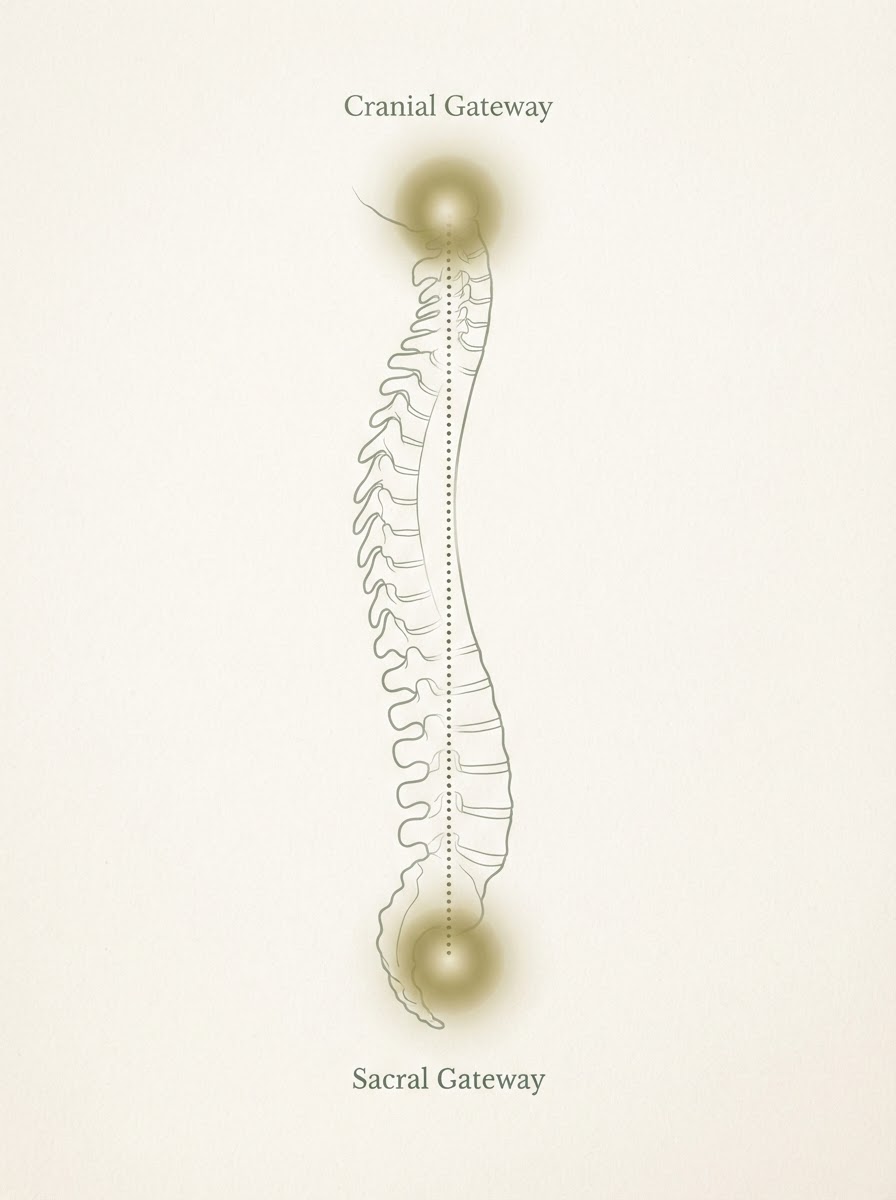
The Cranial Gateway (Top of the Spine)
Located at the base of the skull and upper cervical neck. This is where the vagus nerve exits the cranium. When stress accumulates here, it creates tension headaches, neck stiffness, jaw clenching (TMJ), and a constant feeling of mental noise.
The Sacral Gateway (Base of the Spine)
Located at the sacrum and coccyx. This area anchors the lower parasympathetic nerve network governing pelvic floor tone, elimination, and reproductive health.
When gentle, highly specific somatic contact is made at these cranial and sacral gateways, it exerts a subtle soothing effect on the central nervous system. It directly stimulates vagal tone, signaling your physiology to immediately apply the internal "brakes."
5. Why Willpower and 'Just Relaxing' Don't Work
Have you ever been deeply stressed and had someone tell you to "just relax" or "take a deep breath"? Did it work? Almost certainly not. In fact, it probably made you feel more frustrated.
There is a profound physiological reason why willpower, positive thinking, or forced relaxation techniques fail when your body is stuck in fight-or-flight: Neuroception.
Coined by Dr. Stephen Porges (developer of Polyvagal Theory), neuroception describes how your autonomic nervous system scans the environment and your internal organs for cues of safety or danger, completely below your conscious awareness.
When your nervous system detects danger—through tight muscles, restricted breathing patterns, and physical spinal blockages—it locks down the brain's higher cognitive centers. Your logical mind takes a back seat to survival instincts.
You cannot talk a nervous system out of fight-or-flight because the threat signal is originating from the bodily tissues up to the brain (bottom-up processing), not from the logical mind down to the body (top-down processing).
Telling a braced body to relax is like telling a smoke alarm to stop ringing while the room is still full of smoke. Until the physical body feels genuine, felt-sense safety, no amount of mental effort will convince the nervous system to drop its defense.
6. The Spinal Flow Approach: Awakening Rest Without Force
This fundamental truth is why the Spinal Flow Technique is so transformative for those struggling with chronic stress, anxiety, and fatigue. Spinal Flow does not use forceful adjustments, deep muscle kneading, or aggressive manipulations. It works completely with the body's innate wisdom and nervous system language.
During a Spinal Flow session:
Light, Intentional Contact: Gentle, deliberate contact is applied to specific anatomical points (Access Points) along your spine, primarily around the sacrum and cranium.
Safety Signalling: This subtle contact communicates directly with the nervous system, bypassing the brain's defense mechanisms. The body registers this soft touch as completely safe, allowing the sympathetic guard to drop.
Unlocking the Spinal Wave: As tension dissolves, the body naturally connects with its own internal energy—initiating a visible, wave-like movement along the spine known as the Spinal Wave.
Deep Systemic Reset: Breath deepens naturally without being forced. Tight muscles melt, internal organ function improves, and your system effortlessly transitions from fight-or-flight into profound parasympathetic rest.
Instead of trying to "fix" or "force" your spine, Spinal Flow creates the safe somatic conditions required for your body to heal and reset itself.
7. Client Experience: Moving From Survival to Restorative Living
What does it feel like to transition out of fight-or-flight and into true nervous system balance?
Clients across Windsor, Amherstburg, and Essex County who receive somatic spinal care through The Rested Body frequently describe a profound sense of coming home to themselves. The transition is both immediate and cumulative:
During the Session
You may feel a deep wave of warmth, cooling or even tingles spreading through your torso, spontaneous soft sighs as your diaphragm releases, or a feeling of deep heaviness and melting into the treatment table.
In the Days Following
Sleep becomes noticeably deeper and more restorative. The habitual knot in your stomach relaxes. You notice you are responding to daily life challenges with calm clarity rather than knee-jerk irritation. Shoulders rest lower, breathing is fuller, and chronic pain softens.
Living in constant survival mode is exhausting. You were not designed to merely survive under continuous physical tension; you were designed to rest, recover, and thrive.
Step Out of Survival Mode and into True Rest
Your nervous system is ready to let go of the burden it has been carrying.
Two locations in Essex County: Experience personalized, gentle somatic bodywork in a 20–40 minute session. Serving Windsor, Amherstburg, Ontario in Essex County.
Book Your Session: Reach out to Jennifer Creed at The Rested Body to reserve your comprehensive nervous system assessment and somatic release session, or book your discovery call today.


Explore How Spinal Flow Can Help
The Spinal Flow Technique Explained
Understand the 33 access points, the spinal wave, and how light-touch care works with your nervous system.
Read moreStudio Sessions & Services
What a fully-clothed, no-cracking studio session looks like — from arrival to unhurried integration.
Read moreNervous System Burnout & Chronic Stress
Help your body downshift out of fight-or-flight and into deep, restorative recovery.
Read moreTension Headaches & Neck Stiffness
Unwind the physical weight of stress and posture fatigue held in your neck, shoulders, and head.
Read moreSomatic Tension & Digestive Discomfort
Address the mind-body connection where emotional stress and chronic tension manifest physically.
Read moreRestless Sleep & Low Energy
Calm the underlying nervous system disruptions that prevent deep, restorative sleep.
Read moreChronic Back, Hip & Sciatic Pain
Release deep-seated tension patterns that keep your lower body locked, braced, and uncomfortable.
Read moreBrain Fog & Mental Overwhelm
Clear the cognitive fatigue and mental clutter caused by a nervous system stuck on high alert.
Read moreCurious If Spinal Flow Is Right for You?
Reading is a start. A warm, no-pressure conversation is the next step.