
Where Does the Body Store Stress? How Physical Pain Holds Unreleased Tension
Explore the physical anatomy of stored emotional and physical stress. Learn how trauma, daily pressure, and nervous system blockages manifest along the 7 spinal gateways, and how gentle somatic release restores ease.
1. Your Body Is Not Broken: It Is Responding to What It Has Been Through
When chronic pain, stiff joints, or persistent back issues become a daily reality, it is easy to view your body as an enemy. We speak about our bodies with frustration: "My back is acting up again," "My shoulders are completely ruined," or "My body just keeps failing me."
We have been conditioned to view physical pain as a purely mechanical flaw—a faulty part that needs to be rubbed, cracked, cut, or medicated into submission. But somatic science and cellular biology tell a vastly different, more compassionate story.
Your body is not broken. Your body is a living historical archive of everything you have ever experienced. Every unexpressed emotion, every period of grief, every physical trauma, every relentless deadline, and every moment where you had to "stay strong" and push through—if it was not fully processed at the time, it left an imprint.
When life demands more than your emotional or nervous system bandwidth can process in the moment, your body steps in to protect you. It stores that unhandled energy deep within your muscles, fascia, and spinal column. The pain you are experiencing today is not a sign of failure; it is your body's intelligent, somatic voice asking for attention, safety, and release.
2. The Somatic Archive: How the Spine and Fascia Hold Stress
How exactly does abstract "stress" turn into concrete physical pain? The secret lies in the intimate relationship between your nervous system, your spine, and your fascia.
Fascia is a continuous, three-dimensional web of connective tissue that wraps around every muscle, organ, nerve, and bone in your entire body. It is rich in sensory nerve endings—in fact, fascia has up to ten times more nerve sensory receptors than muscle tissue.
   [ Unprocessed Stress / Trauma ]
              │
              ▼
   [ Nervous System Threat Response ]
              │
              ▼
   [ Fascial Contraction & Fluid Restriction ]
              │
              ▼
   [ Physical Blockage in Spinal Gateway ]
              │
              ▼
      [ Localized Pain & Discomfort ]
When you experience stress or trauma:
Chemical Signal: The nervous system floods the tissue with stress chemicals.
Fascial Tightening: The fascia responds instantly by contracting and thickening.
Fluid Loss: Healthy fascia is fluid, hydrated, and glides easily. Stressed fascia loses water, turning sticky, rigid, and dense.
Spinal Blockage: Because fascia anchors directly into the spinal periosteum (the outer membrane of spinal bone), tight fascia pulls vertebrae out of natural ease, creating persistent physical blockages along the spine.
This localized tension restricts nerve flow, reduces oxygenated blood supply to nearby tissues, and traps fluid. What began as an emotional or mental load becomes a physical, tangible knot locked in your spine.
3. The 7 Spine Gateways: Mapping Tension from Base to Awaken
In the Spinal Flow Technique, we recognize that the human spine is divided into 7 distinct Gateways. Each Gateway houses specific spinal nerves, corresponds to distinct anatomical zones, and acts as a storage point for different categories of life stress.
By mapping where pain and stiffness reside along these 7 Gateways, we can understand what your body is holding onto:
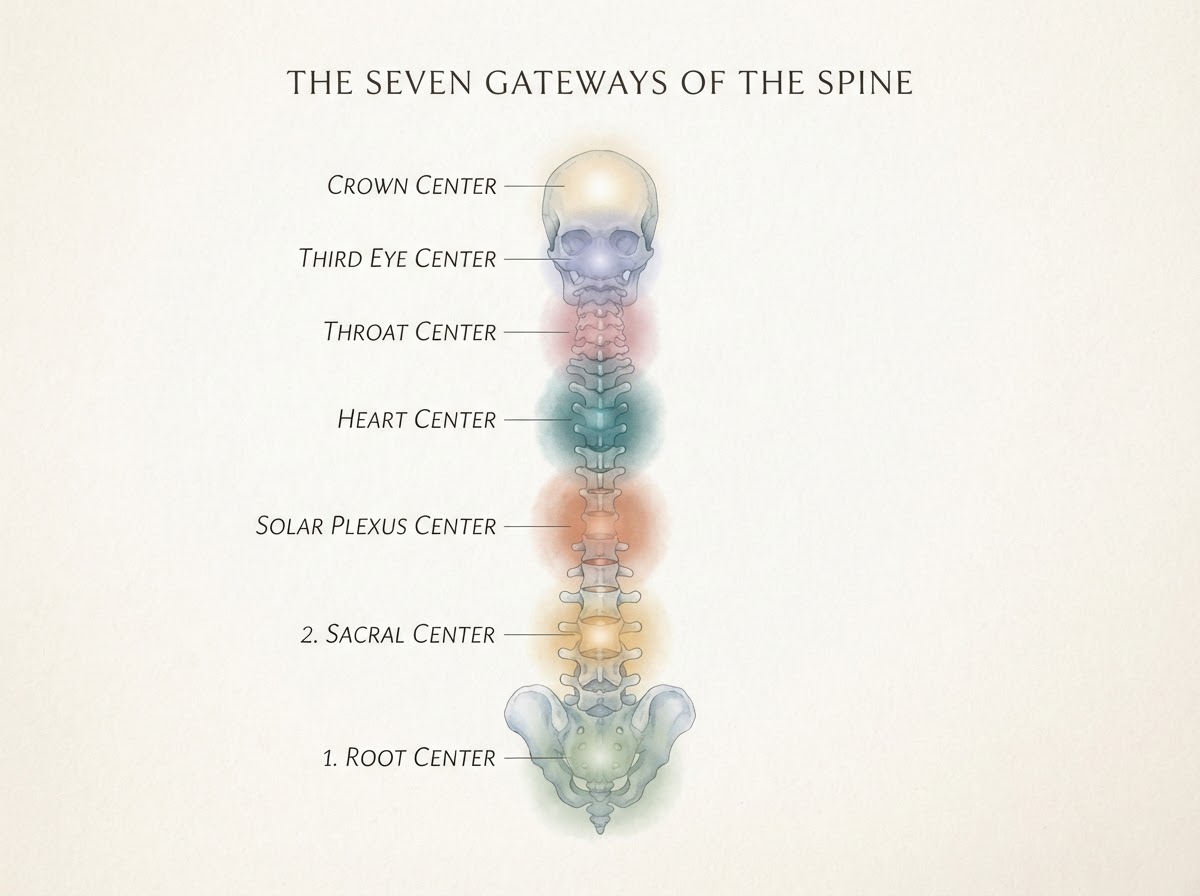
1. The Base Gateway (Coccyx)
Physical Connections: Coccyx, pelvic floor, hips, feet, and legs.
Stored Stress: Survival instinct, foundational security, financial worries, deep-seated emotional trauma, and feelings of root instability.
Physical Manifestation: Sciatica, tailbone pain, deep pelvic floor tension, severe lower back stiffness.
2. The Foundation Gateway (Sacrum)
Physical Connections: Sacral joint, reproductive organs, bladder, knees.
Stored Stress: Burdens of responsibility, family pressures, relationship strain, feeling unsupported in life.
Physical Manifestation: Chronic hip tension, aches, structural instability, SI Joint dysfunction, digestive sluggishness.
3. The Power Gateway (Lumbar Spine)
Physical Connections: L1–L5, solar plexus area, adrenals, stomach, liver, kidneys.
Stored Stress: Internal drive, perfectionism, control, burnout, anxiety, feeling "not enough."
Physical Manifestation: Digestive issues, mid-back stiffness, adrenal fatigue, shallow breathing.
4. The Centre Gateway (Thoracic Spine)
Physical Connections: T1–T12, heart, lungs, chest, mid-back, thoracic spine.
Stored Stress: Unexpressed grief, heartbreak, emotional pain, self-protection, feeling closed off.
Physical Manifestation: Postural slouching, tightness between the shoulder blades, shallow chest capacity, heart palpitations.
5. The Passion Gateway (Base of Neck, Lower Cervical Spine)
Physical Connections: Neck vertebrae (C3–C7), upper shoulders, thyroid, throat, arms, hands.
Stored Stress: Suppressed communication, carrying the "weight of the world," over-giving, fear of speaking one's truth.
Physical Manifestation: Severe shoulder tightness, chronic neck tension, thyroid imbalances, numbness in arms or fingers.
6. The Pause Gateway (Upper Cervical Spine)
Physical Connections: Neck vertebrae (C1–C2), vocal cords, jaw, ears.
Stored Stress: Over-thinking, mental overwhelm, boundary issues, inability to slow down or pause.
Physical Manifestation: Neck pain, stiffness when turning the head, jaw clenching (TMJ), frequent sore throats.
7. The Awaken Gateway (Cranium)
Physical Connections: Skull base, brainstem, central nervous system.
Stored Stress: Disconnection from self, chronic mental stress, sensory overload, existential anxiety.
Physical Manifestation: Tension headaches, migraines, brain fog, dizziness, sleep disturbances.
4. What Happens During a Somatic Release?
When you step out of effort-based healing and receive gentle, targeted somatic care, your body finally feels safe enough to release the stored stress trapped within these Gateways.
A somatic release is not a dramatic, painful ordeal. It is a natural, organic unwinding process led entirely by your central nervous system. During a Spinal Flow session, as blockages clear, clients frequently experience:
Spontaneous Respiratory Shifts: A sudden, deep involuntary breath or a soft series of sighs as the diaphragm releases its lifelong tension.
Softening Tissues: Hard, fibrous muscle tissue rapidly transforms, becoming warm, pliable, and soft under gentle contact.
The Involuntary Wave: The spine begins to exhibit smooth, rhythmic micro-movements (unwinding). The body instinctively wiggles, stretches, or gently ripples to clear accumulated tension along the nerve pathways.
Thermal and Emotional Releases: Sensations of gentle warmth spreading through cold limbs, tingling along nerve channels, or a quiet release of tears accompanied by an immediate wave of profound emotional lightness.
This is the sound of your body clearing its historical archive—releasing stored survival stress so your system can return to present-moment ease.
5. Breaking the Cycle: Shifting from Effort to Receiving Care
Many people approach healing as if it were a second full-time job. They work hard at stretching, push through painful physical therapy exercises, track every symptom meticulously, and try to force their body to comply with aggressive daily routines.
However, when your nervous system is exhausted from holding years of stress, adding more effort to your healing journey can actually maintain the underlying stress loop. You cannot force a flower to bloom by pulling on its petals, nor can you force a nervous system to heal through aggressive effort.
True somatic healing requires a fundamental shift: moving from effort to receiving. Healing happens when you lie down in a safe, quiet space and allow a skilled practitioner to listen to your body's subtle signals. It occurs when you stop pushing and allow your central nervous system to be held, supported, and guided back to its natural, self-healing state.
6. Multiple Locations of Supported Healing Across Windsor-Essex
At The Rested Body, Jennifer Creed specializes in facilitating this deep shift from effort to ease; offering gentle, quiet somatic spinal care across Windsor and Amherstburg, Ontario in Essex County.
Through the gentle, non-invasive practice of Spinal Flow, stored stress in your 7 Gateways is safely unraveled, layer by layer, restoring space to your spine, clarity to your mind, and deep peace to your life.
Map Your Spine & Release Stored Tension
Your body has held your story for long enough. It is time to offer it the rest and release it deserves.
Schedule a call: Living in or visiting Windsor, Amherstburg, and surrounding Essex County, or just curious? Book a discovery call to learn more and discuss your specific needs.
Schedule Your Consultation: Connect with Jennifer Creed by phone, text or email today and schedule an initial consultation or discuss upcoming session availability.


Explore How Spinal Flow Can Help
The Spinal Flow Technique Explained
Understand the 33 access points, the spinal wave, and how light-touch care works with your nervous system.
Read moreStudio Sessions & Services
What a fully-clothed, no-cracking studio session looks like — from arrival to unhurried integration.
Read moreChronic Back, Hip & Sciatic Pain
Release deep-seated tension patterns that keep your lower body locked, braced, and uncomfortable.
Read moreNervous System Burnout & Chronic Stress
Help your body downshift out of fight-or-flight and into deep, restorative recovery.
Read moreTension Headaches & Neck Stiffness
Unwind the physical weight of stress and posture fatigue held in your neck, shoulders, and head.
Read moreBrain Fog & Mental Overwhelm
Clear the cognitive fatigue and mental clutter caused by a nervous system stuck on high alert.
Read moreSomatic Tension & Digestive Discomfort
Address the mind-body connection where emotional stress and chronic tension manifest physically.
Read moreCurious If Spinal Flow Is Right for You?
Reading is a start. A warm, no-pressure conversation is the next step.