What Actually Happens During a Spinal Flow Session? (A Step-by-Step Walkthrough)
No mystery, no jargon — just a clear, honest walkthrough of what a gentle Spinal Flow session feels like from arrival to integration.
One of the most common questions we hear is also one of the simplest: what actually happens during a session? It's a fair question. When a modality is gentle and light-touch, it can be hard to picture what's really going on — and whether something so subtle can actually create change.
So here's an honest, step-by-step walkthrough of a typical Spinal Flow session, from the moment you arrive at the studio to the moment you're resting afterward. No mystery, no jargon.
Before the session: setup and arrival
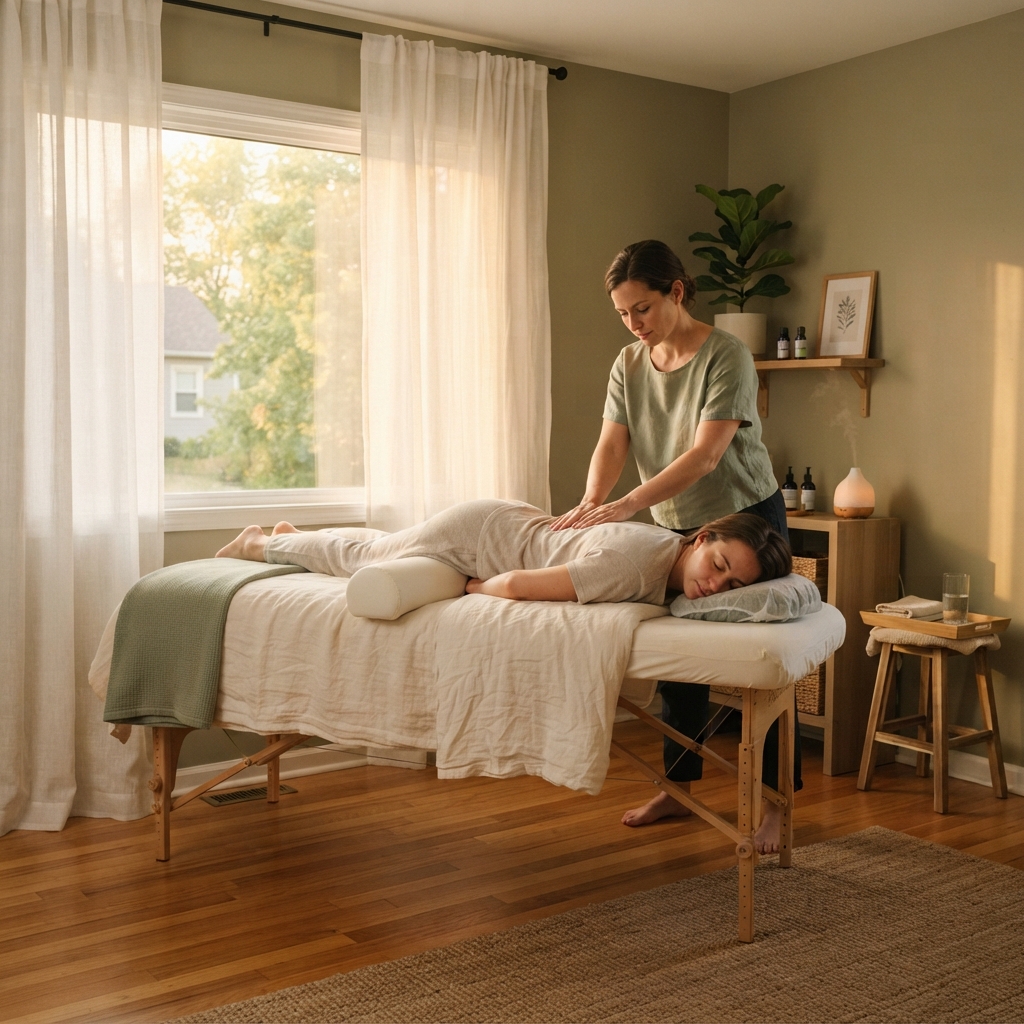
Your practitioner makes sure the room is calm, essential oil diffusers add to the ambiance, light meditative music is playing, the table is set up, linens are laid, and the room is made comfortable. There's no clinical waiting room, no fluorescent lighting, no rush. You feel like you've stepped into a place where you can finally let your guard down and rest.
Step 1: the intake conversation
Every first session begins with a conversation. This isn't a formality — it's an essential part of the work. Your practitioner wants to understand your history, your current patterns, what you've tried, and what your body has been holding. They'll ask about your symptoms, but also about stress, sleep, and the broader context of your life.
This matters because Spinal Flow treats the whole nervous system, not just the spot that hurts. The intake helps your practitioner understand the pattern they're working with, so the session can be tailored to your body's specific needs.
For follow-up sessions, this conversation is shorter — a check-in on what's shifted since your last visit, and what your body is asking for today.
Step 2: getting comfortable on the table
You lie down fully clothed on the table. That's worth repeating: fully clothed, no disrobing, no oils. Comfortable, loose clothing is ideal — loose yoga pants or sweatpants and a soft shirt. Try to avoid jeans or any thick clothing that blocks the spine or sacrum. Clean socks are a must.
Once you're settled, your practitioner takes a moment to help your body arrive. They may place a hand gently on your sacrum and simply hold still. This first contact is light — almost nothing — but it begins the conversation with your nervous system. It says: you're safe here.
Step 3: light-touch contact on the access points
This is the heart of the session. Your practitioner makes gentle, sustained contact with specific access points along your spine, sacrum, and cranium. There are 33 of these points in the Spinal Flow system, the majority are in the sacrum. The practitioner pays careful attention to the way the body and breath are responding to each point of contact, and while they are guiding the flow of your system, it is your body that leads the way. No two sessions are the same, it all depends on what your body is presenting that day and what you share has happened between sessions.
The contact is genuinely light — the weight of a coin, not the pressure of a massage. There's no cracking, no popping, no forceful manipulation, and no repositioning of your body once the session begins. Your practitioner holds each point for a period of time, allowing your nervous system to respond and then waits for a signal or cue from your body when it's time to choose another or guide the flow accordingly.
What happens during this contact is subtle but profound. Your nervous system, receiving the signal of safety, begins to downshift out of fight-or-flight and into the parasympathetic rest-and-digest state. As it does, the deep postural muscles that have been bracing your spine begin to soften. Stored stress begins to unspool from the tissues. The natural wave motion through your spine is encouraged to return.
What you might feel
Everyone experiences a session differently, but some sensations are common. Many people feel their breath deepen noticeably — sometimes with a sigh as the body releases. You may feel warmth, a sense of lengthening through the spine, or a subtle unwinding in areas you didn't realize were tight.
It's also very common to feel your mind quiet. The mental chatter that usually accompanies a braced nervous system begins to settle. A significant number of people drift into a light sleep during a session, which is completely natural — it's a sign the nervous system is finally feeling safe enough to rest.
Occasionally, as stored tension releases, you might notice a brief emotional sense — a wave of calm, a flicker of something held, a feeling of letting go. This is normal and is always within your capacity, because the work happens at your body's own pace. As emotions flow, there may be a moment you feel you need to let them out. This is ok. Remember, during your session you are in a safe space to do so.
Step 4: the Spinal Wave
One of the distinctive features of Spinal Flow is the emergence of what's called the spinal wave — a natural, rhythmic motion that moves through the spine as tension releases. As the nervous system settles and the bracing softens, the spine begins to express its own inherent movement.
This wave isn't something your practitioner does to you; it's something your body does on its own once it's given the safety to do so. It's a sign that the system is unwinding, not being wound. Some people feel it clearly; others barely notice it. Either way, it's the body doing its own healing work.
Step 5: closing and integration
As the session nears its end, your practitioner gently brings the contact to a close. They'll often hold a final point — frequently at the feet or the sacrum — to help your body integrate the work and settle into its new state.
Table time is typically 25 to 40 minutes, with the full session (including intake) running 45 to 60 minutes for an initial visit. When the session is complete, your practitioner may give you some suggestions of what to do, to integrate what has come up in the session, or how to prepare for the next one.
After the session: why the studio matters
This is where the studio setting reveals one of its greatest advantages. It becomes the place your body instantly recognizes as safety for your mind, the moment you step back in.
Many people find this post-session window is when the deepest integration happens. The nervous system, having experienced safety, continues to unwind on its own through the night and even the next morning. Changes can be noticed as long as you are paying attention to your body.
A few honest notes
Spinal Flow isn't a one-session miracle. As we become aware of the layers of stress we are carrying and just how long we have been holding onto tension, (even before the pain started) we acknowledge the nervous system needs time to unwind and reset. The recovery starts in the session, continues as you leave, and the momentum is built in the frequency of sessions. Lasting change with chronic patterns usually unfolds over a series of visits as your nervous system learns, session by session, that it can settle and stay settled. Some people feel a dramatic shift after one session; others notice change more gradually. Both are normal.
What it is, consistently, is gentle, respectful, and attuned to your body's own pace. There's no force, no cracking, and no pushing past what your system can handle. Just a quiet conversation between light touch and a nervous system that's finally being invited to let go.
If that sounds like the kind of care your body has been waiting for, the best first step is a simple conversation. A free discovery call lets you ask anything that's on your mind, share what you've been experiencing, and decide together whether a session is the right next step for you.


Explore How Spinal Flow Can Help
Curious If Spinal Flow Is Right for You?
Reading is a start. A warm, no-pressure conversation is the next step.