What Are Spinal Gateways and Blockages? A Beginner's Plain-English Guide
Two words you'll hear a lot in Spinal Flow — explained simply, without the jargon. Here's what gateways and blockages actually mean for your body.
If you spend any time exploring the Spinal Flow Technique, you'll quickly run into two words: gateways and blockages. They sound a bit technical, but the ideas behind them are surprisingly intuitive — and once you understand them, you'll have a much clearer picture of why this gentle modality can create such deep change.
So let's translate them into plain English.
The body's natural flow
To understand gateways and blockages, it helps to start with a simple image: your body has a natural flow to it. This isn't mystical — it's the inherent movement, rhythm, and communication that travels through your spine and nervous system every moment you're alive. Your breath moves through you. Cerebrospinal fluid pulses. Nerve signals travel up and down. Muscles engage and release in coordinated waves.
When everything is working well, this flow is fluid and uninterrupted. Your nervous system moves freely between activation and rest. Tension comes and goes. Your body responds to life and then settles back down. This is what we'd call a healthy, unblocked system.
But life doesn't always leave that flow intact.
What is a blockage?
A blockage is exactly what it sounds like: a place where the body's natural flow has become restricted or stuck. And here's the key insight: blockages aren't flaws or malfunctions. They're protective.
When your body experiences stress — whether physical (an injury, poor posture, repetitive strain), chemical (toxins, poor nutrition, medication load), or emotional (grief, anxiety, overwhelm) — your nervous system responds by creating a kind of holding pattern. It braces. It tightens. It essentially puts up a roadblock to protect the area while it deals with the perceived threat.
In the short term, this is brilliant. The bracing stabilizes an injured area, conserves energy, and keeps you functioning through a crisis. The problem arises when the threat passes but the blockage remains. The nervous system, having learned that bracing equals safety, keeps the roadblock in place long after it's needed.
Over time, these blockages accumulate. One here from that car accident years ago. Another there from a period of chronic work stress. Another from an emotion that was never fully processed. Each one restricts the flow a little more, until the system as a whole becomes stiff, braced, and prone to pain, fatigue, and dysfunction.
This is why chronic pain often feels like it comes from nowhere — because it's not coming from a single event. It's the cumulative effect of many small blockages that the body has been quietly maintaining.
What is a gateway?
If blockages are the roadblocks, gateways are the on-ramps. Gateways are specific access points along the spine and cranium — there are 33 of them in the Spinal Flow system — where a practitioner can make gentle contact to communicate directly with the nervous system.
Think of gateways as the body's built-in communication ports. They're points where the nervous system is particularly receptive to input. When a trained practitioner makes light, sustained contact at a gateway, it's like sending a clear, calming message straight to the system's control center.
That message is simple: you're safe now. The threat has passed. You can let go.
This is the genius of the gateway approach. Rather than trying to force a blockage open from the outside — which would just trigger more bracing — the practitioner uses the gateways to help the nervous system recognize that the protective holding is no longer needed. And when the system believes it's safe, it releases the blockage on its own, in its own time.
How the two work together
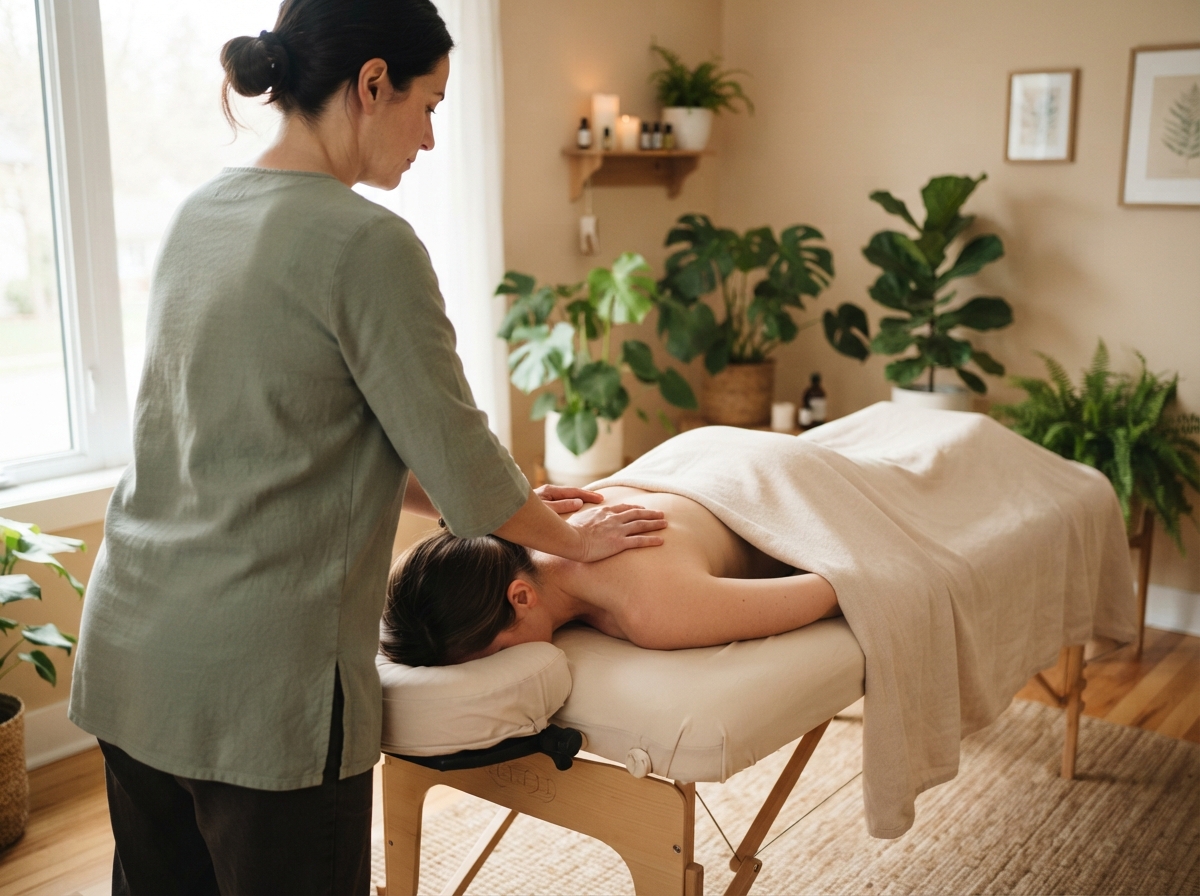
A Spinal Flow session is essentially a conversation between gateways and blockages. Your practitioner assesses which gateways to work with based on where your body is holding blockages that day. They make gentle contact at the appropriate gateways, and your nervous system responds by beginning to unwind the corresponding blockages.
As a blockage releases, the natural flow returns to that area of the spine. The bracing softens. The muscles let go. The wave motion through the spine is restored. And because the release came from within — because the nervous system chose to let go, rather than being forced — the change tends to last.
This is why Spinal Flow can reach tension that more forceful approaches can't. It's not working against the body's protective patterns; it's working with them, helping the system update its safety assessment so it no longer feels the need to brace.
Why this matters for your healing
Understanding gateways and blockages reframes the entire healing journey. It means your pain isn't a sign that something is broken — it's a sign that your body is still trying to protect you, just a little too diligently. And it means lasting relief doesn't come from forcing the protection away, but from helping your nervous system feel safe enough to release it voluntarily.
It also explains why Spinal Flow is so gentle. There's no need for force, because the body does the releasing itself once it receives the safety signal through the gateways. The practitioner's role isn't to fix you — it's to create the conditions in which your body can do what it already knows how to do.
A note on pace
Because blockages often represent years of accumulated holding, they rarely all release at once. A session typically unwinds a layer or two, and over a series of visits, the system gradually clears more and more of the old holding. This is why many people feel progressively better over time, rather than all at once — the body is doing deep, lasting work at its own pace.
If you've been carrying tension, pain, or stress for a long time, there's a good chance your body has built up its share of blockages. The encouraging news is that they were never permanent — they were just waiting for the right signal. And that signal, delivered gently through the gateways, is something you can experience for yourself, in the comfort of your own home.


Curious If Spinal Flow Is Right for You?
Reading is a start. A warm, no-pressure conversation is the next step.